Stittsville Doesn't Need to Wait. Here's How a Councillor Fixes Speeding.
**One tool isn't a plan.** Cameras came and went. The problem stayed. Here's what actually works — and what I'll do starting day one.
I see it every day.
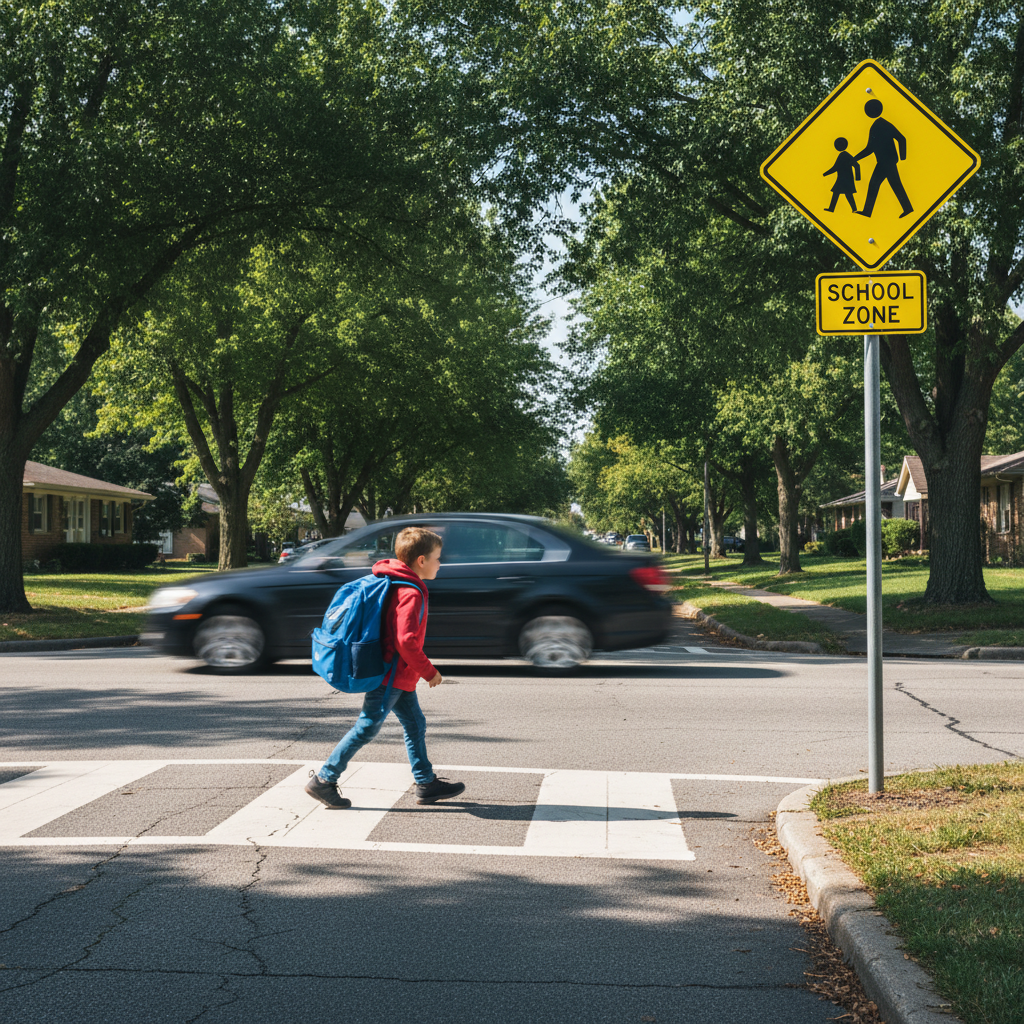
On Abbott. On Stittsville Main. On Hazeldean. On Iber. On Maple Grove. On Rosehill. Drivers blowing through school zones, blasting past pedestrian crossings, treating residential streets like the 417.
It's not just the arterials. Vivera Place. Warmstone — quiet streets in my own neighbourhood where you'd think drivers might ease off. They don't.
This is what Stittsville lives with — every morning, every afternoon school pickup, every weekend. And here's the truth nobody at City Hall wants to say out loud: those drivers were speeding when the cameras were up, too. A ticket arriving in the mail two weeks later was never going to fix this.
Stittsville is done waiting for the right answer.
One tool isn't a plan.
Talk to a few neighbours right now, and you'll hear the same instinct: just bring the speed cameras back.
I understand the impulse. The cameras at Sacred Heart, St. Stephen, and Holy Spirit did slow drivers at those specific sites. The province pulling them was a setback. And after watching speeds creep back up for months, it feels like the obvious answer is to turn the cameras on again.
But the obvious answer isn't the right answer.
And here's why so many people land on the same instinct: it's the only narrative City Hall has been telling. The 87%-to-41% compliance number gets quoted at every meeting. The fact that those cameras only ever covered three school zones — out of dozens of corridors that need protection — barely gets mentioned. The international evidence on what actually works is rarely brought up at all. When residents only hear half the picture, the easy answer looks like the right one.
The countries with the safest roads in the world — Sweden, the Netherlands, Norway, Finland — don't choose between cameras and infrastructure. They use both. In a specific order:
• Lower the default residential speed limit to 30 km/h. Sets the cultural baseline.
• Redesign streets so 30 km/h feels right. Narrow lanes, raised crosswalks, chicanes, trees planted close to the road. The road itself enforces the limit.
• Use automated enforcement on the arterials where geometry can't be changed — bus routes, emergency corridors, the wide roads that have to stay wide.
And they layer them together — because no single tool fixes speeding on its own.
Sweden runs 2,300 speed cameras for 10.5 million people. But Sweden also has 30 km/h residential limits and streets designed to enforce them. The cameras work because the streets work first.
Ottawa skipped steps one and two. We jumped straight to step three. We put cameras on a few school zones in a city where the residential default is still 50 km/h, and the streets are designed to feel like 60. That's why those cameras started to feel like a tax. Not because automated enforcement is a bad tool — but because we deployed it without the foundation.
Stittsville families are already stretched thin. Mortgages. Groceries. Daycare. Hydro. A $100–$200 ticket in the mail because you drifted to 51 in a 40 zone at 7 a.m. on the way to drop your kid off at school — that isn't road safety. That's what happens when you skip the first two steps and bill families to cover the difference.
The money to build the foundation has been in our property taxes all along. The political will to spend it hasn't been.
The easy answer is to ask for the cameras back. But that alone won't fix the problem — steps one and two were never built to begin with. I'm saying, think practical: build steps one and two first, and then survey residents on whether step three is still needed. Because a camera in front of one school can't protect a kid on a tricycle three streets over. A camera on Stittsville Main can't slow a driver cutting through your subdivision on a Saturday afternoon.
A camera punishes speeding. A redesigned street prevents it. We need practical, proven redesign first.
Cameras came and went. The problem stayed.
If you live on Brae Crescent, you already knew. The city's own speed studies in 2023 clocked 85th-percentile speeds of 49 km/h on a 40 zone. If you live on Kittiwake Drive, you knew — measured speeds of 48 to 52.5 km/h on a 40 zone, past a park where kids bike. If you live on Maple Grove, on Springbrook, on Sweetnam, on Forest Creek, on Fringewood, on Hobin near A. Lorne Cassidy — you've been calling 311, writing the councillor's office, filling out consultation surveys for years, and hearing the same answer:
We'll study it. We'll consult. We'll put it on the list. Maybe next budget cycle.
That answer was never good enough. Camera or no camera, it never was.
Look at the numbers. The annual $50,000 our ward gets for temporary traffic calming buys flex stakes — the yellow plastic poles you see on West Ridge, on Springbrook, on Liard. They reduce speed by 5 to 10 km/h on a good day, and they're seasonal. What we actually need is concrete: speed humps, raised crossings, narrower lanes, bulb-outs. Permanent. Year-round. Enforcing the speed limit through physics, not paperwork.
Meanwhile, the real fixes keep getting pushed down the road. The Stittsville Main fix is supposed to come when the Robert Grant Avenue extension diverts north-south traffic (knock on wood) — 5 to 10+ years away. Hazeldean Road urbanization with proper pedestrian and cycling facilities? Who knows — beyond 10 years. Carp Road widening starts this year — and every Stittsville driver knows what that means: more cut-through traffic on Maple Grove, on Hobin, on every residential street that becomes a workaround.
The city has done real work — speed studies on Brae, on Kittiwake. Traffic calming meetings. Flex stakes installed year after year. None of it has been wasted. But Stittsville has been growing twice as fast as the safety infrastructure that's supposed to protect us — and the strategy we have left depends on tools, like the cameras, that we no longer have.
The current answer from City Hall is to file the right forms, run another study, and hope something changes by 2030.
That's not acceptable.
What Helsinki proves.
The country that built the framework was Sweden — Vision Zero, passed by their parliament in 1997, holds one principle: no road death is an acceptable trade-off. The Netherlands invented the design vocabulary fifty years ago — woonerfs, the living streets where cars are guests and the road itself signals the right speed.
But Helsinki is the most striking recent proof. The Finnish capital just completed an entire 12-month stretch with zero road deaths — of any kind. Their formula: starting in 2021, more than half of Helsinki's streets dropped to 30 km/h, especially residential areas and school zones. Streets redesigned to feel that way. Cameras layered on top, on the corridors where redesign couldn't reach. Oslo, Norway hit zero pedestrian and cyclist deaths the same way.
Helsinki is a city of nearly 700,000 people. Stittsville is roughly a tenth of that. If a Nordic capital with ice, snow, and ten times our population can go a full year without a single road death — what's Ottawa City Council's excuse?
The international evidence is unambiguous: dropping the residential default from 40 km/h to 30 km/h roughly cuts a pedestrian's fatality risk in a collision in half. That isn't a policy preference. That's physics.
What I'll do, starting day one.
I'm not running to explain what a province should do, or what a councillor can't do. I'm running to do what a councillor can.
The reason it hasn't happened isn't jurisdiction. It's priorities.
Stittsville deserves a councillor who builds — not one who manages decline politely, and not one who promises a single tool will fix what only a full plan can. On speeding, here's what I'll deliver:
• Start compiling Ward 6's permanent traffic-calming priority list in my first term — starting with school zones. Speed humps. Raised pedestrian crossings. Narrowed lanes. Bulb-outs where appropriate. Not flex stakes. Not "studies pending consultation." A real schedule of what gets built where, and when.
• Use the powers a councillor already has — on day one. Within my first 180 days, I'll move council motions to lower posted speed limits on streets the city has already confirmed are dangerous: Brae, Kittiwake, Maple Grove, Springbrook. I'll initiate new speed studies on residential streets the city hasn't measured in years. None of this requires provincial permission or a new budget cycle. These powers are already on the books. They're just sitting unused.
• A Stittsville fair-share fight for the road safety capital budget. Our ward is one of the fastest-growing in the city. We pay our share of property taxes. We deserve our share of physical safety infrastructure. Fair share isn't a slogan. It's a balance sheet — and I'll bring it to budget committee with the receipts, not just talk about it in a newsletter.
• A Ward 6 traffic-calming acceleration list. Every street where the city's own speed studies have already confirmed there's a problem — Brae, Kittiwake, Springbrook, Maple Grove, Sweetnam, Forest Creek — moves to the front of the build queue. If we've studied it once, we don't need to study it again. We need to build it — working with residents on every street.
• A public quarterly Ward 6 traffic safety dashboard. Right now, nobody — not you, not me — can tell you how many speeding complaints have come out of Stittsville, or which streets are first in line for fixes. The data exists. It just isn't shared. As your councillor, I'll put it online: complaints by street, response times, fixes installed, fixes still waiting. If we can't measure it, we can't fix it.
• No more "we'll study it" as a final answer. Studies are useful — once. If Brae has had two speed studies confirming what residents already know, the answer isn't a third study. The answer is the speed humps the city already drew up.
You don't need a camera to know your street is unsafe.
You know it on Abbott. You know it on Iber. You know it on Maple Grove, on Rosehill. You know it on Vivera Place, on Warmstone — on the street you live on right now. You know it when you flinch as your kid bikes to school. You know it when the dog walker on your street steps off the curb twice before they make it home.
Cameras alone were never going to fix this anyways. They could only reach three school zones in a ward with more than a dozen dangerous corridors waiting on concrete infrastructure. The answer is to build the foundation the world's safest cities already proved works: lower limits, redesigned streets, raised crossings, narrower lanes. Permanent infrastructure that slows every car, every day, in real time — not just the ones a camera catches. Infrastructure that actually prevents collisions before they happen, that keeps our kids and our elderly safe in the moment that matters — not two weeks later when a ticket arrives in the mail.
That's what I'll fight for. On every Ward 6 street. Starting day one.
Stittsville is done waiting.
On October 26th — show up.
Sheetal Narwal
Candidate, City Councillor — Ward 6 (Stittsville)
Sources
• City of Ottawa, "Changes coming to automated speed enforcement" (November 2025) — Bill 56 timeline and end of the ASE program.
• City of Ottawa Public Works and Infrastructure Committee report, April 2026 — driver compliance at former camera sites fell from 87% to 41%; 2026 Road Safety Action Plan capital budget reduced from $15M to $7.5M.
• Councillor Glen Gower, "Q&A: Automated Speed Enforcement in Stittsville" (January 2025) — three Stittsville ASE camera locations (Sacred Heart, St. Stephen, Holy Spirit).
• Councillor Glen Gower, traffic calming consultation summaries (2024–2025) — speed studies on Brae Crescent (49 km/h 85th percentile on a 40 zone), Kittiwake Drive (48–52.5 km/h on a 40 zone), Sweetnam Drive, Maple Grove, Springbrook, Forest Creek.
• Councillor Glen Gower, "Map of future transportation projects in Stittsville" (April 2026) — Robert Grant Avenue extension (5–7 years out), Hazeldean Road urbanization (beyond 10 years), Carp Road widening (starting 2026).
• Global News, "A clear setback: More drivers speeding in Ottawa with photo radar gone" (April 15, 2026); CBC News, "Ottawa's speed cameras go dark" (November 25, 2025) — post-camera speeding data and ASE removal timeline.
• Helsinki's 12-month zero-road-deaths period (July 2024 – August 2025) and 30 km/h policy — EU Urban Mobility Observatory; Yle (Finnish national broadcaster); Road Safety Trust; Newsweek.
• Sweden's 2,300 speed cameras; 38.6% reduction in road fatalities under Vision Zero; Dutch 30 km/h zones as residential standard since 1984 — Swedish Transport Administration; European Transport Safety Council; OECD International Transport Forum.
• Pedestrian fatality risk at 30 km/h vs higher speeds — World Health Organization Global Status Report on Road Safety.
Sheetal Narwal
Candidate for Ottawa City Councillor – Ward 6, Stittsville
Continue exploring Sheetal's platform: